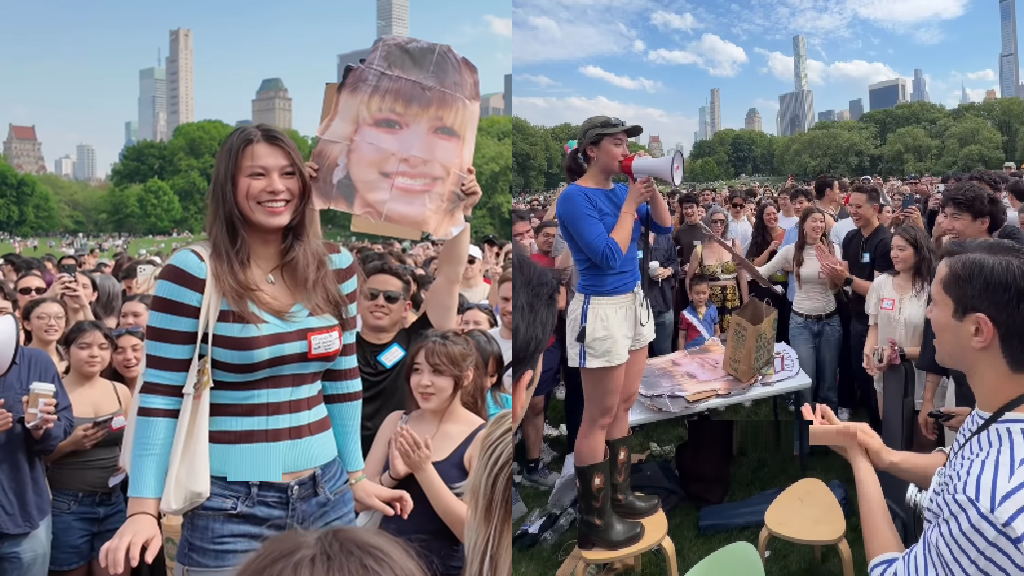
A social meetup for Wasians, promoted through community page Half Asian Spring, drew more than 3,000 people to Central Park’s Sheep Meadow on May 10, where attendees filmed street interviews, joined celebrity look-alike contests and celebrated shared experiences of growing up mixed-race. After videos from the event spread online, critics questioned why a gathering tied to broader “Half Asian” branding focused almost entirely on people who are part white.
“Half Asian” or just Wasian?
Much of the criticism focused on the difference between Half Asian Spring’s broader branding and the meetup’s Wasian-centered promotion. While event listings described the meetup as open to mixed Asians and allies, critics said the promotional videos and flyers told a different story.
“Every single video posted to this account only mentions Wasians,” TikTok creator Welcometomadsworld pointed out. “Every single flyer only mentions Wasians. It’s only marketed as a Wasian meetup.”
The timing of the event during AAPI Heritage Month intensified those reactions. “Instead of centering and celebrating your Asian heritage, you’re celebrating the fact of your whiteness and internalizing and centering that whiteness during a month that is made for Asian heritage,” TikToker Yourblasianprincess said. She also criticized the meetup for excluding “Hispanic people slash Latino people who are also mixed with Asian and just Asian people in general.”
Who gets seen online
Several viral clips from the event asked attendees to name their favorite Wasian celebrities or compare public figures during look-alike contests. Among the celebrities highlighted include Laufey, Alysa Liu, Hudson Yang and Charles Melton, among others. Black-Asian and Latino-Asian public figures rarely receive the same level of attention online or in entertainment, Welcometomadsworld said.
“The only mixed-race Asian representation that exists on this scale is Wasian representation,” TikTok creator Suyuscope explained. “The closer to whiteness you are in your mixed identity and in your appearance, the more legible and accepted your mixed identity is going to be.”
This dynamic reflects a measurable difference in how different mixed-race groups experience social acceptance and proximity to whiteness. A 2015 Pew Research Center study found that white and Asian biracial adults were more likely to say they had “a lot in common” with white people than Asian people, 60% compared with 33%. The same study found they were more likely to say they felt accepted “very well” by white people than Asian people, 62% compared with 47%.
The “hard W” debate
In his Substack essay titled “Start Wasian Hate?”, Latino-Asian writer Aki Lee Camargo questioned why “Wasian” had become a highly visible online identity category while terms such as “Asian American” and “AAPI” emerged from pan-Asian political organizing and anti-racist activism in the U.S.
“Wasia’s popularity is insidious because the identity will always be defined in relation to whiteness. You can’t be Wasian without the hard ‘W,’” Camargo wrote. He then criticized what he described as phenotype-based representation surrounding Wasian visibility online. “But representation of what, exactly? A phenotype? Because if Wasian identity begins and ends with aesthetics, that’s eugenics.”
Historian and creator Kahlil Greene raised similar concerns in his piece “NYC’s ‘Wasian Wonderland’ Shows How Mixed-Race Hype Still Centers Whiteness.” “What’s being celebrated here is not just mixedness, but a specific kind of mixedness that remains closely tied to whiteness,” Greene noted.
“We just wanted community”
For many attendees, the meetup reflected a shared experience of growing up mixed-race rather than an attempt to exclude others. Some described finally seeing large numbers of people with similar family backgrounds gathered in one place.
“Being proud of being Wasian is not the same as saying I am proud to be white,” one Reddit commenter wrote. “It means I am proud of this specific combination of white and Asian and the experience that comes with existing in between categories.”
Some supporters argued the backlash increasingly turned into hostility toward Wasians generally rather than scrutiny of the organizers or event branding. “I’m upset that wasians are being shit on from every angle right now whether they went to the event or not,” one commenter wrote.
The Rebel Yellow reached out to one of the meetup’s organizers for comment and will update this story if a response is provided.
This story is part of The Rebel Yellow Newsletter — a bold newsletter from the creators of NextShark, reclaiming our stories and celebrating Asian American voices.
Subscribe free to join the movement. If you love what we’re building, consider becoming a paid member — your support helps us grow our team, investigate impactful stories, and uplift our community.