



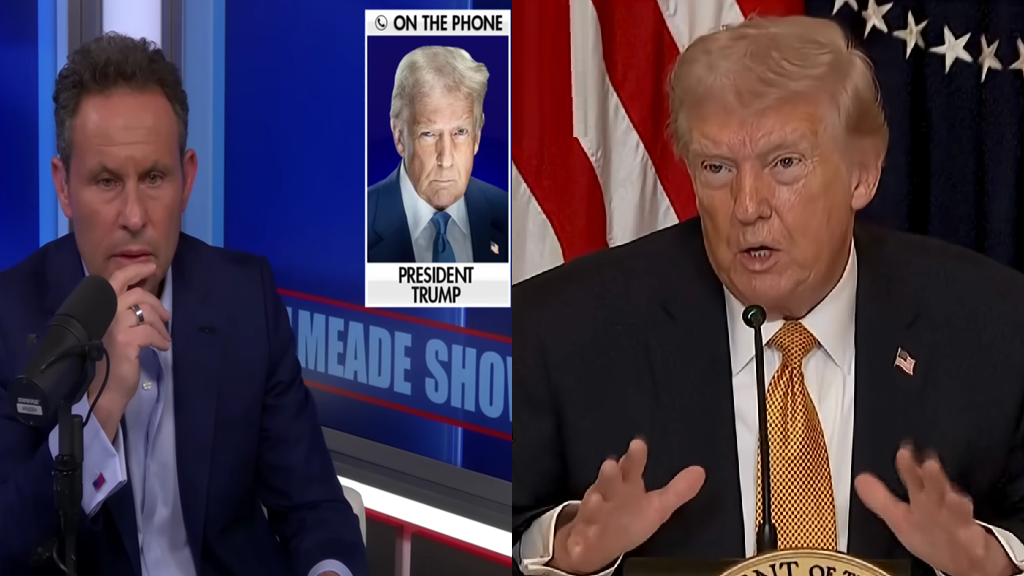
President Donald Trump told “Fox & Friends” host Brian Kilmeade, who is white, that immigrants do not have “your genetics” during a Friday phone interview on immigration. He paired the statement with claims that migrants entering the U.S. are criminals and should be barred. By linking criminal behavior to biology, Trump’s comments suggested a fundamental racial distinction between migrants and white Americans.
Trump’s eugenics language
Trump made the remarks while responding to questions about violent incidents involving individuals identified as Muslim, arguing that some “shouldn’t have been let in” while others “go bad.” He said, “They’re sick people, and a lot of them were let in here. They shouldn’t have been let in,” before adding, “Others are just bad. They go bad. Something wrong — there’s something wrong there.”
He then attributed that behavior to biology, saying, “The genetics are not exactly your genetics, it’s one of those problems, Brian. It’s a terrible thing, and it happens, it happens too often,” linking criminality to inherited traits rather than individual actions or circumstances.
The language reflects a core idea associated with eugenics, the long-debunked belief that social outcomes such as crime or behavior are determined by genetics and differ across groups. That framework has historically informed exclusionary immigration policies and was a defining feature of Nazi racial ideology under Adolf Hitler, where hereditary difference was used to justify hierarchy and exclusion.
Not hiding white supremacism
Trump’s comments drew criticism from policy analysts and journalists, many of whom focused on his use of genetics to describe immigrants and its historical implications.
David J. Bier, director of immigration studies at the Cato Institute, wrote that the language reflects ideas that have shaped past U.S. immigration restrictions, stating, “Trump is an old-school eugenicist nativist. He actually is fine with immigrants as long as they have the right ‘genes.’”
Journalist Alex Cole pointed to what he described as a contradiction in Trump’s framing, writing on X, “Imagine being the grandson of immigrants, who dyes his hair, paints his face orange, and wears lifts, lecturing the country about ‘genetics.’ The irony writes itself.”
Journalist Mehdi Hasan offered a more direct characterization: “He’s a white supremacist. He doesn’t hide it.”
History of rhetoric invoking “blood,” genetics
Trump’s reference to “genetics” builds on years of rhetoric in which he has described immigrants as threats defined by identity and, more recently, by genes.
At the launch of his first presidential campaign in 2015, Trump framed immigration in terms of crime, describing Mexican immigrants as “rapists” bringing “drugs” and “crime” into the U.S. That framing established a baseline argument centered on behavior and threat. As president in 2020, he repeatedly referred to COVID-19 as the “China virus,” a label that researchers and scholars later linked to a documented rise in anti-Asian hate incidents.
By 2023, his rhetoric had shifted more explicitly toward heredity. At multiple campaign events, Trump said immigrants were “poisoning the blood of our country,” invoking language that historians and analysts have noted parallels earlier exclusionary ideologies. The phrasing closely mirrors passages in Hitler’s “Mein Kampf,” which originally warned of national decline through “blood poisoning.”
While some Trump supporters have dismissed comparisons to the Nazi leader as exaggerated, the overlap extends beyond rhetoric, as his use of biological language has been paired with policies, including restrictions and bans on immigration from Muslim-majority countries, sweeping limits on asylum at the southern border, large-scale deportation operations, aggressive ICE enforcement actions, immigrant detention facilities that have faced criticism over conditions and efforts to strip citizenship from certain naturalized Americans, among others.
This story is part of The Rebel Yellow Newsletter — a bold weekly newsletter from the creators of NextShark, reclaiming our stories and celebrating Asian American voices.
Subscribe free to join the movement. If you love what we’re building, consider becoming a paid member — your support helps us grow our team, investigate impactful stories, and uplift our community.

Join the conversation+