



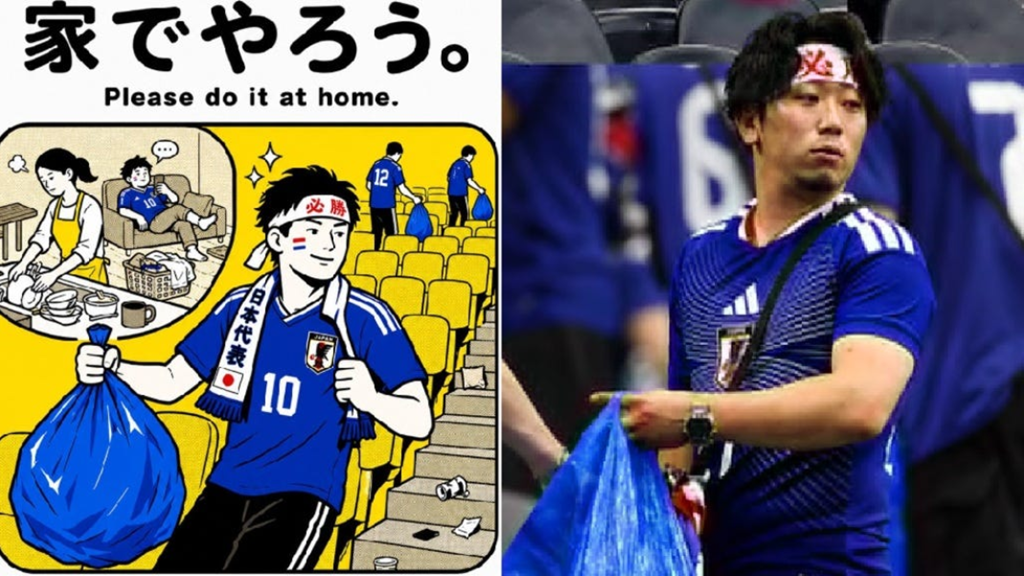
Japanese World Cup fans once again drew international praise this week after supporters were seen cleaning up stadium stands following matches. Within hours, a viral social media post challenged the celebration, arguing that Japanese men spend the least time on housework among developed nations. The post drew nearly 2 million views and ignited debate over unpaid labor, childcare and gender roles inside Japanese households.
A scholar’s different view of World Cup praise
Among the most widely shared responses came from Atsuko Tamada, a French literature scholar, who published a parody of Tokyo Metro’s etiquette posters after FIFA highlighted Japanese supporters cleaning up World Cup stadiums.
The poster showed a smiling Samurai Blue fan carrying a bag of trash through a stadium aisle while a woman washed dishes and sorted laundry in the background. Across the top appeared the slogan “Please do it at home.” Beneath the illustration, Tamada wrote: “Japanese men spend among the least time on housework internationally. Please share unpaid care work at home.”
As the image spread, Tamada followed it with research and statistics about household labor in Japan. One post argued that while differences in income and working hours partly explain the imbalance, Japanese husbands’ participation in housework and childcare remains relatively low. Citing research on married couples, she noted that husbands’ participation often stays around 20% even when wives contribute significantly to household income.
In another post, Tamada pointed to what researchers have described as a “gender display” effect, writing that men’s participation in housework and childcare can decline when wives become the primary earners. She argued that stronger economic contributions by women can sometimes reinforce traditional gender expectations rather than weaken them. In a later post, Tamada connected the discussion to broader concerns about sexism in Japan, writing, “There is much more to say about sexism in this country.”
Online reactions
The image quickly spread beyond soccer circles, appearing alongside videos and photos celebrating Japanese fans’ cleanup efforts. Many users embraced the joke, saying it reflected frustrations that receive far less attention than Japan’s reputation for tidying stadiums after matches.
One commenter wrote that while Japanese supporters may clean up after games, “most of them don’t do that at their own home.” Another user joked that wives struggling with husbands who avoid household chores should make them wear Samurai Blue uniforms while cleaning. A separate commenter suggested that some of the men being praised for collecting trash after matches may have left childcare responsibilities to their wives while attending the tournament.
Others rejected the criticism with one user questioning how anyone could know the private lives of the men shown in cleanup photos. Another argued that discussions about unpaid labor often overlook the longer hours many men spend in paid employment. Some commenters also objected to what they viewed as a sweeping generalization about Japanese men.
Statistics behind the debate
According to Japan’s Cabinet Office, citing 2021 data from the Organisation for Economic Co-operation and Development, women in Japan spend 5.5 times more time than men on unpaid work such as shopping, domestic chores and caregiving.
The disparity is significantly larger than in Britain, France and the United States, where women spend 1.8 times, 1.7 times and 1.6 times longer than men on unpaid work, respectively. A separate Japanese government survey found that men spent an average of 51 minutes a day on unpaid domestic labor compared with three hours and 24 minutes for women.
Japan coach Hajime Moriyasu praised the cleanup tradition associated with Japanese soccer supporters. “I think this is one part of the Japanese culture that we can be proud of in the world,” Moriyasu said ahead of Japan’s match against Tunisia.
Moriyasu also acknowledged hearing criticism from people who questioned whether fans picking up trash could take work away from cleaners. “They said, by picking up people’s garbage it would be clean, but wouldn’t you be taking away the work from the cleaners?” he said. “So I guess that is one way of looking at it.”
This story is part of The Rebel Yellow Newsletter — a bold newsletter from the creators of NextShark, reclaiming our stories and celebrating Asian American voices.
Subscribe free to join the movement. If you love what we’re building, consider becoming a paid member — your support helps us grow our team, investigate impactful stories, and uplift our community.

Join the conversation+