



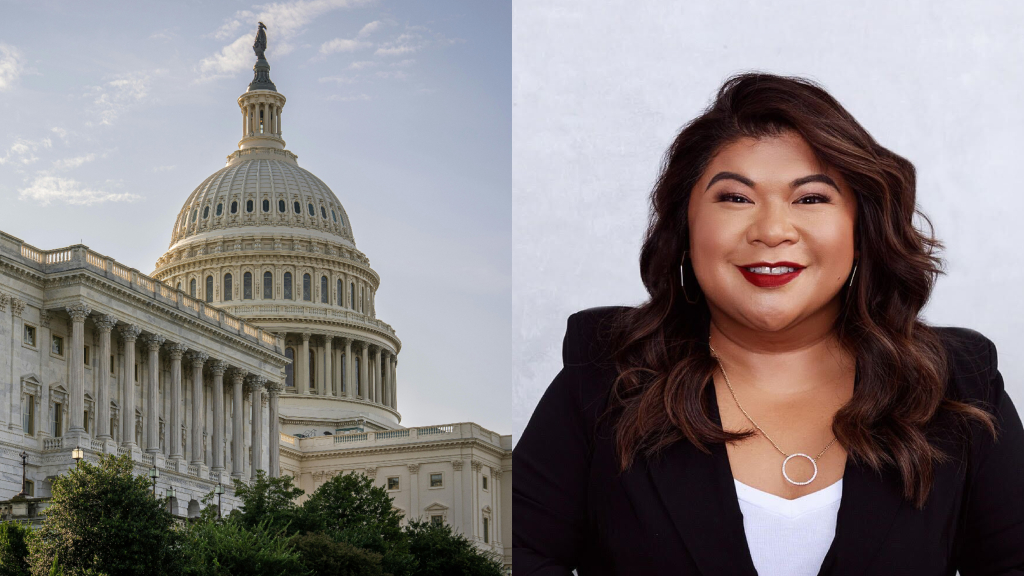
With a Friday deadline looming for Department of Homeland Security (DHS) funding, AAPI advocates are pressing lawmakers to withhold billions from immigration enforcement.
In an exclusive interview with The Rebel Yellow, Christina Baal-Owens, executive director of the National Asian Pacific American Women’s Forum (NAPAWF), argues that the system has “already proven cruel and deadly,” pointing to last month’s Minneapolis shootings that claimed the lives of two U.S. citizens.
A system awash in funding
ICE’s budget has already nearly doubled from the previous year through last summer’s One Big Beautiful Bill Act (OBBBA). Baal-Owens says the two-week Senate extension postpones accountability for an agency with few meaningful constraints.
“This expanded funding functions as a $170 billion slush fund for the agency to spend over four years with little oversight,” she notes.
The reconciliation bill included $178 billion in total for DHS, with $75 billion earmarked specifically for ICE — funding that continues flowing even during a shutdown. That financial reality, combined with Congress having already secured full-year funding through October for 96% of federal operations, has led Democrats to block any DHS appropriation without substantial enforcement reforms.
For her part, Baal-Owens frames the standoff as fundamentally about whether Congress will impose life-saving restrictions rather than ensure operational continuity. “Even in these two weeks, we will see irreparable harm done to AAPI communities, as every day that aggressive enforcement continues means deeper fear, trauma and the real possibility of more deaths,” she warns. Revoking unchecked enforcement funding, prohibiting ICE operations at sensitive locations and restoring due process protections, she says, are crucial for lawmakers to pursue.
Retraumatizing through racial profiling
Enforcement tactics in Minnesota have included federal agents asking residents where Asian people live. The climate of fear has reached even elected officials, including St. Paul’s Hmong American mayor, Kaohly Her, who has resorted to carrying her passport constantly to avoid potential detention.
For Baal-Owens, these incidents reflect a pattern of systemic discrimination. “What we are seeing is the reactivation of a very old and very dangerous narrative: that Asian people are perpetual foreigners whose belonging is always conditional,” she explains.

Hmong families in Minnesota, many of whom were refugees from U.S. wars in Southeast Asia, face particular trauma from the current crackdown. “These are communities with living memory of state violence, forced displacement, surveillance and detention,” Baal-Owens recalls. The anxiety manifests in concrete ways throughout the community: children miss school, families forgo medical care or trips to grocery stores and older residents increasingly stay home.
When this climate of fear extends to city leadership itself, she argues, it sends an unmistakable message of danger to every AAPI household, fostering widespread anxiety that “reshapes daily life and erodes trust in the very institutions that are supposed to serve and protect us.”
From invisibility to action
The Minnesota killings have exposed what Baal-Owens calls the “illusion that immigration enforcement is just a border issue or a Latine issue,” forcing recognition that AAPI communities have long been sidelined in immigration policy conversations. She stresses that this oversight stems from stereotypes that portray Asian Americans as economically secure and insufficient data tracking — problems that mask actual impacts. In fact, Asian Americans constitute the largest refugee population, with about 22,500 admitted annually over the past decade, and make up roughly one in seven undocumented immigrants nationwide.
In response, NAPAWF is working to transform widespread outrage into lasting policy reforms. The organization’s strategy extends beyond blocking the DHS funding bill to pursuing broader systemic changes, including a shift toward family unity instead of enforcement-first approaches, eliminating immigration-status requirements for accessing health care and social programs and improving both data collection methods and availability of services in community languages.
“You cannot protect communities you refuse to see,” Baal-Owens says, pointing to her group’s support for the Health Equity and Access under the Law (HEAL) Act, which would restore Medicaid and Medicare access regardless of immigration status.
The question, as Baal-Owens frames it, is existential: “Will we continue to fund systems that terrorize communities, or will we invest in the ones that actually keep people safe?” This is now central to high-stakes negotiations in Washington. With DHS funding set to expire Friday, Senate Minority Leader Chuck Schumer and House Minority Leader Hakeem Jeffries have submitted 10 reform demands to the White House and Republican leaders, including requirements for judicial warrants before entering private property and mandating that agents display identification.
Democrats have dismissed the administration’s initial counterproposal as “incomplete and insufficient.” Asian American lawmakers including Sens. Tammy Duckworth (D-Ill.) and Andy Kim (D-N.J.) have joined the call to oppose DHS funding, with Kim stating, “I’m not voting to fund this lawless violence.”
This story is part of The Rebel Yellow Newsletter — a bold weekly newsletter from the creators of NextShark, reclaiming our stories and celebrating Asian American voices.
Subscribe free to join the movement. If you love what we’re building, consider becoming a paid member — your support helps us grow our team, investigate impactful stories, and uplift our community.

Join the conversation+