
Asian Americans are the country’s only racial or ethnic group whose worry outpaces hope, amid mounting pressures from federal immigration enforcement, trade policy and deepening questions about identity and place in American society, according to a new national survey.
Key findings
The 2026 Social Tracking of Asian Americans in the U.S. (STAATUS) Index, released by The Asian American Foundation (TAAF) and conducted by NORC at the University of Chicago, found that worry (44%) ranked above hope (40%) as the most commonly reported emotion among Asian Americans and Pacific Islanders. This is a distinction no other racial or ethnic group shared, because among white (50%), Black (53%) and Hispanic (44%) Americans, hope ranked as the top response.
Now in its sixth year, the survey drew responses from 1,778 U.S. adults between Jan. 16 and Feb. 10, 2026. TAAF CEO Norman Chen said the results point to a persistent gap between AAPI lived experience and public perception. “The latest STAATUS Index provides our clearest look yet at the disconnect between how AAPIs experience life and how the rest of the country perceives us,” he said. “Despite our community’s growing power, a significant share of the public is still forming views about America’s fastest-growing racial group with no direct connection or information.”
Federal policy, local impact
Beyond public perception, the survey asked AAPIs about the impact of specific federal policies on their community. Seventy-one percent of AAPIs said tariffs on goods imported from countries like China or India have hurt Asian American communities, compared with 47% of U.S. adults overall. AAPIs were also more likely than the general public to say that efforts to detain and deport more undocumented immigrants (63% vs. 44%) and higher fees or tighter rules for skilled worker visas (67% vs. 43%) have hurt Asian American communities.
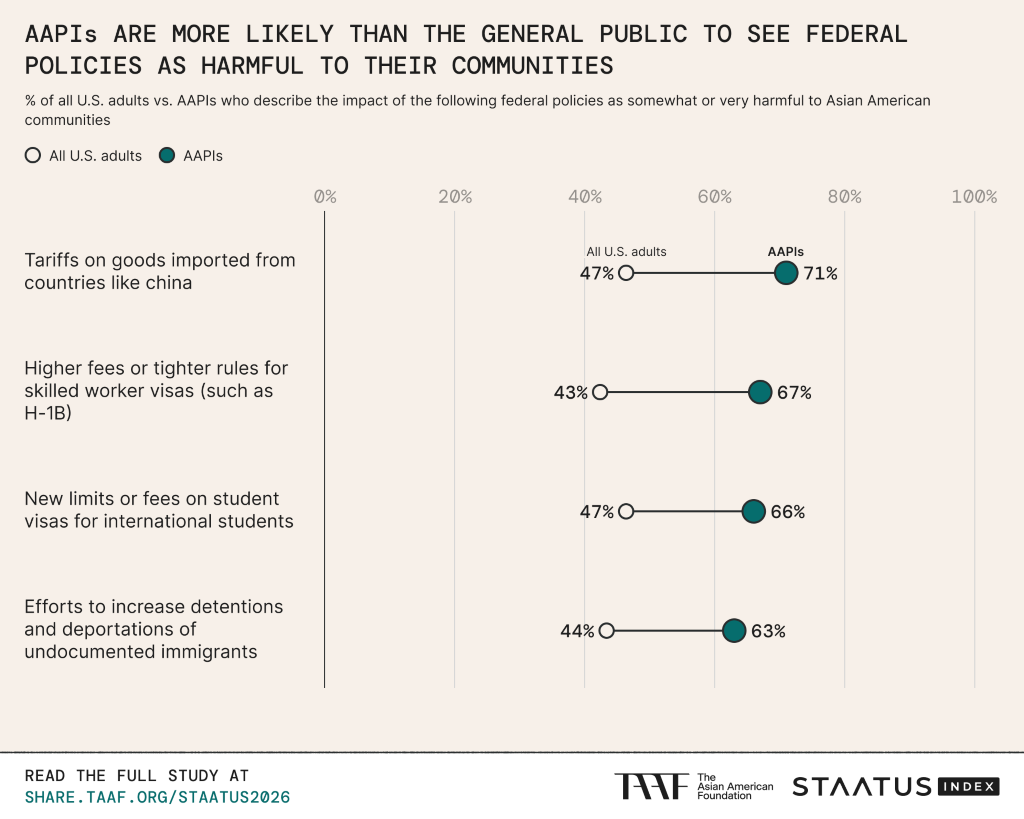
A majority of AAPIs (61%) also expressed distrust in the Immigration and Customs Enforcement’s (ICE) ability to enforce immigration laws fairly and safely in their communities, versus 51% of the general public. A similar gap emerged on new limits on student visas, with 66% of AAPIs citing a negative impact compared with 47% of U.S. adults overall. The index also found that 22% of AAPI adults reported being insulted or called a bad name because of their race or ethnicity in the past 12 months. Another 20% reported being harassed or threatened and 5% said they were physically attacked or assaulted.
A divided sense of belonging
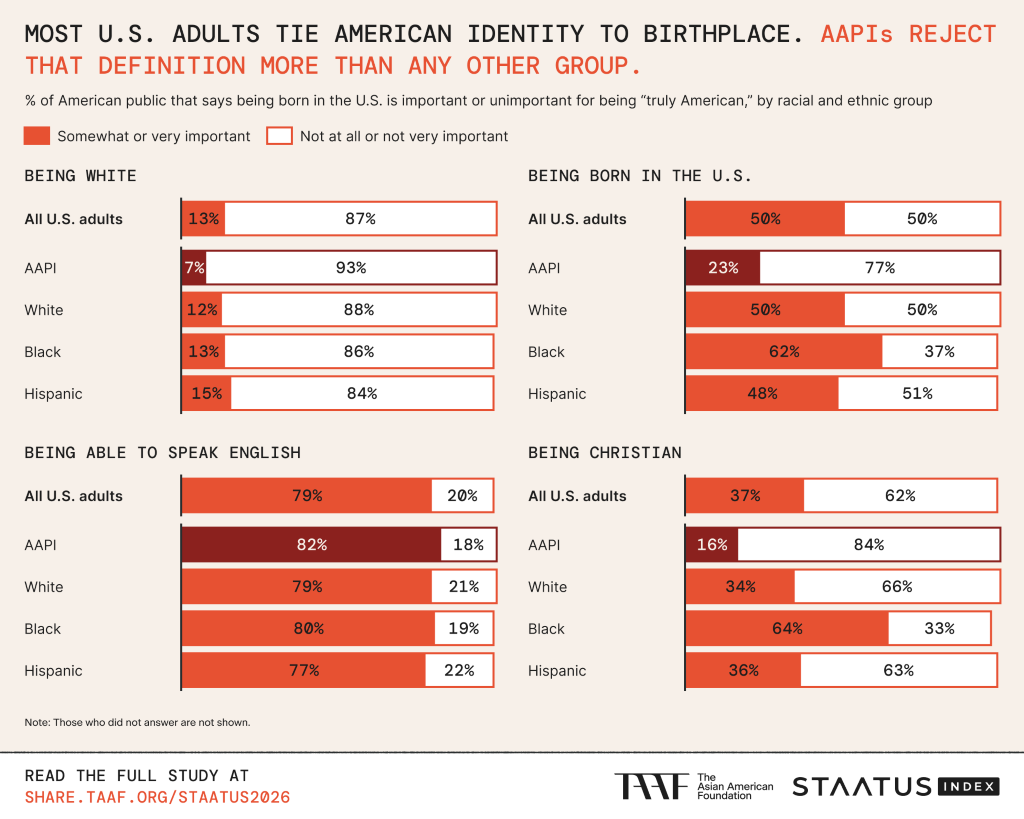
Interestingly, the survey found a deeper fracture over identity and belonging. With a Supreme Court ruling on birthright citizenship expected this summer, half of U.S. adults (50%) say being born in the country is important to being “truly American.” However, 77% of AAPIs do not share that view, which is more than any other racial or ethnic group. AAPIs are also the most likely group to reject definitions of American identity tied to race or religion, with 93% saying being white and 84% saying being Christian are unimportant to American identity.
That inclusive vision of American identity stands in contrast to how much of the public racially categorizes AAPIs themselves. The general public is more likely to see the status of Asian Americans as closer to white people (57%) than to people of color, a view especially common among white Americans (64%). But among AAPIs themselves, 74% say their status more closely resembles that of people of color. Three-quarters of AAPIs (75%) say they feel they belong in the U.S. overall, compared with 83% of white Americans.
Still unseen
How little Americans know about AAPI communities is also painted in the survey. Twenty-six percent of U.S. adults report having no personal connection to an Asian American, no friend, neighbor or coworker, and 31% say they have no source of information about AAPI communities. A majority of Americans (53%) are unable to name even one significant moment or policy in Asian American history. Separately, one in five U.S. adults say they are concerned that Chinese Americans pose a threat to U.S. society, echoing longstanding concerns about the targeting of Chinese Americans during periods of geopolitical tension.
Only 7% of U.S. adults believe AAPIs have a great deal of influence on U.S. culture, though a staggering 77% acknowledge their impact on food and restaurants. Still, AAPIs themselves register the highest support for inclusion among all groups surveyed, with two-thirds (66%) saying they support diversity, equity and inclusion (DEI) initiatives. That’s well above the 48% of U.S. adults overall who said the same, suggesting the community continues to advocate for inclusion even as survey data shows worry outpacing hope among its members.
Read the full 2026 STAATUS Index here.
This story is part of The Rebel Yellow Newsletter — a bold newsletter from the creators of NextShark, reclaiming our stories and celebrating Asian American voices.
The Rebel Yellow is supported in part by funding from The Asian American Foundation (TAAF). Funders do not influence story selection, reporting, or editorial decisions. All editorial content is independently produced by The Rebel Yellow team.
Subscribe free to join the movement. If you love what we’re building, consider becoming a paid member — your support helps us grow our team, investigate impactful stories, and uplift our community.